Rhinoceros Hornbill
Buceros rhinoceros
Quick answer
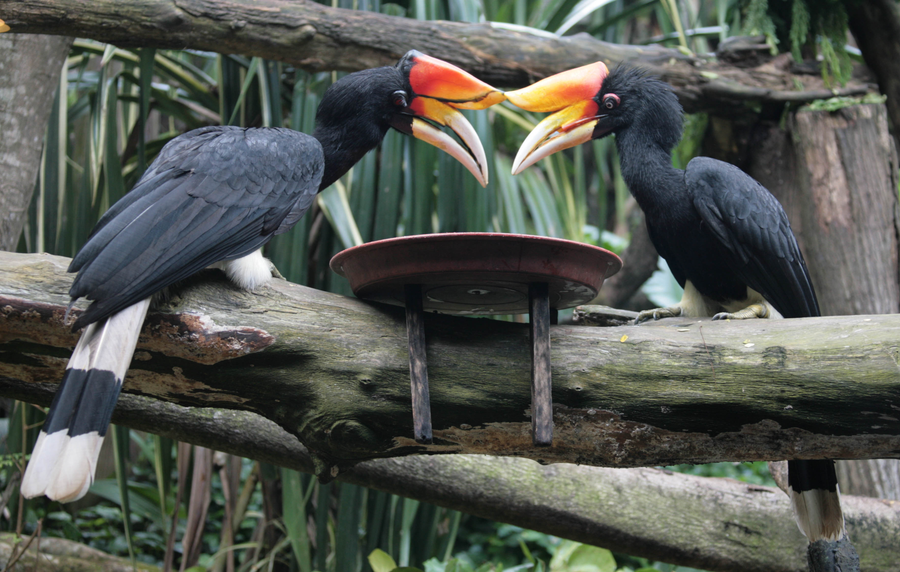
The rhinoceros hornbill is a huge black-and-white bird with a dramatic orange-red casque atop an enormous bill, found in rainforests of Southeast Asia. Females seal themselves inside tree-cavity nests while males deliver food, and the species is listed Vulnerable from logging and hunting.
Rhinoceros Hornbill facts at a glance
| Scientific name | Buceros rhinoceros |
|---|---|
| Diet | Omnivore — fruit, small animals, and insects |
| Habitat | Lowland and hill rainforests of Southeast Asia |
| Lifespan | 30–35 years in the wild |
| Weight | 2–3 kg (4.4–6.6 lb) |
| Top speed | Powerful flier through forest gaps; heavy wingbeats |
| Conservation status | Vulnerable (IUCN) |
| Kingdom | Animalia |
|---|---|
| Phylum | Chordata |
| Class | Aves |
| Order | Bucerotiformes |
| Family | Bucerotidae |
| Genus | Buceros |
Where it lives
Lowland and hill rainforests of Malaysia, Indonesia, Brunei, Thailand, and Sumatra — Borneo is a stronghold for rhinoceros hornbills.
What is a group of rhinoceros hornbills called?
Group name (collective noun)
A group of Rhinoceros Hornbills is called a flock.
Baby name
A baby Rhinoceros Hornbill is called a chick.
Explore more animal collective nouns and baby animal names .
Casque and bill
The hollow casque is thought to amplify calls that carry through dense forest — males announce territory with resonant honking. The massive bill is used to pluck fruit and capture lizards and nestling birds, yet the hornbill's centre of gravity is adjusted by hollow bone structure.
Nest sealing ritual
Females enter a tree hollow and seal the entrance with mud, droppings, and fruit pulp, leaving only a slit for the male to pass food. She moulted flight feathers during incubation and depends entirely on the male for weeks — one of bird world's most extreme breeding commitments.
Seed dispersers
Hornbills swallow fruit whole and regurgitate or defecate seeds far from parent trees, making them vital gardeners of tropical forests. Loss of hornbills reduces regeneration of large-seeded trees such as figs and durians.
Conservation
Listed Vulnerable from deforestation, poaching for casques and tail feathers used in traditional dress, and capture for the pet trade. Protected areas in Malaysia, Indonesia, and Thailand support populations, but lowland forest loss continues across the range.
Dig deeper into the Rhinoceros Hornbill
- Are Hornbill Endangered
Dig deeper into rhinoceros hornbill — are hornbill endangered.
- Hornbill Facts 5
Dig deeper into rhinoceros hornbill — hornbill facts 5.
- How Long do Hornbill Live?
Dig deeper into rhinoceros hornbill — how long do hornbill live.
- What do Hornbill Eat
Dig deeper into rhinoceros hornbill — what do hornbill eat.
- Where do Hornbill Live?
Dig deeper into rhinoceros hornbill — where do hornbill live.
Explore the Rhinoceros Hornbill
Compare
Related Birds
Collections
Range & geography
Did you know? Rhinoceros Hornbill facts
- The rhinoceros hornbill is a huge black-and-white bird with a dramatic orange-red casque atop an enormous bill, found in rainforests of Southeast Asia.
- The casque is a hollow keratin structure atop the bill, used in displays and calls — not a true horn like a rhino's.
- Females wall themselves in to protect eggs and chicks from predators such as monitor lizards and snakes, relying on the male to deliver all food.
- Lowland rainforests of Malaysia, Indonesia, Brunei, Thailand, and Sumatra — Borneo is a stronghold.
- Rhinoceros hornbills are Vulnerable, not yet Endangered, but declining as lowland rainforest is logged and fragmented.
- Conservation: Vulnerable (IUCN).
Diet & feeding
Rhinoceros Hornbill feeds primarily as a omnivore — fruit, small animals, and insects. Females enter a tree hollow and seal the entrance with mud, droppings, and fruit pulp, leaving only a slit for the male to pass food. She moulted flight feathers during incubation and depends entirely on the male for weeks — one of b
Adaptations
- The hollow casque is thought to amplify calls that carry through dense forest — males announce territory with resonant honking. The massive bill is used to pluck fruit and capture lizards and nestling birds, yet the hornbill's centre of gravity is adjusted by hollow bone structure.
- Females enter a tree hollow and seal the entrance with mud, droppings, and fruit pulp, leaving only a slit for the male to pass food. She moulted flight feathers during incubation and depends entirely on the male for weeks — one of bird world's most extreme breeding commitments.
Behaviour & ecology
- The hollow casque is thought to amplify calls that carry through dense forest — males announce territory with resonant honking. The massive bill is used to pluck fruit and capture lizards and nestling birds, yet the hornbill's centre of gravity is adjusted by hollow bone structure.
- Females enter a tree hollow and seal the entrance with mud, droppings, and fruit pulp, leaving only a slit for the male to pass food. She moulted flight feathers during incubation and depends entirely on the male for weeks — one of bird world's most extreme breeding commitments.
- Hornbills swallow fruit whole and regurgitate or defecate seeds far from parent trees, making them vital gardeners of tropical forests. Loss of hornbills reduces regeneration of large-seeded trees such as figs and durians.
Communication
- Rhinoceros Hornbill uses calls and visual displays to communicate territory, alarm, and breeding status.
- Vocal repertoires vary by species and are often learned or refined during development.
Habitat & range
Lowland and hill rainforests of Southeast Asia
Ecological role
Rhinoceros Hornbill contributes to seed dispersal, insect control, or nutrient cycling depending on diet and foraging habits.
Frequently asked questions about the Rhinoceros Hornbill
What is the horn on a hornbill?
The casque is a hollow keratin structure atop the bill, used in displays and calls — not a true horn like a rhino's.
Why do hornbills seal the nest?
Females wall themselves in to protect eggs and chicks from predators such as monitor lizards and snakes, relying on the male to deliver all food.
Where do rhinoceros hornbills live?
Lowland rainforests of Malaysia, Indonesia, Brunei, Thailand, and Sumatra — Borneo is a stronghold.
Are hornbills endangered?
Rhinoceros hornbills are Vulnerable, not yet Endangered, but declining as lowland rainforest is logged and fragmented.
What do hornbills eat?
Mostly fruit, especially figs, plus insects, lizards, and small vertebrates when available.
What is a group of rhinoceros hornbills called?
A group of Rhinoceros Hornbills is called a flock.
What is a baby rhinoceros hornbill called?
A baby Rhinoceros Hornbill is called a chick.
Sources & references
This guide is compiled and reviewed against established zoological and conservation references. Key sources for the Rhinoceros Hornbill:
-
IUCN Red List of Threatened Species
Conservation status (Vulnerable) reflects the IUCN Red List category for Buceros rhinoceros.
- IUCN Red List — Buceros rhinoceros.
Conservation status (Vulnerable) and population trends.
- Animal Diversity Web — Buceros rhinoceros. University of Michigan Museum of Zoology.
Life history, morphology, and range.
-
Global Animal Guide editorial standards
How we research, source, review, and update every guide for accuracy.